Last time, you learned how to express doubts in various ways, e.g. “日本語は難しいのかな (I wonder if the Japanese language is difficult),” and “日本語は簡単なんじゃないか (I suppose the Japanese language is easy).” As you can see, the explanatory のだ often appears in a lot of sentence patterns to give some nuances. In this lesson, you will learn a related expression わけだ.
Explanation for How the Explanatory わけだ Works
|
Table of Contents
Conjugation Rule
Affirmative Sentences
Interrogative Sentences
Negative Sentences
Summary
|
The origin of わけだ comes from the kanji 訳 which means “reason,” “cause,” and “meaning.” Thus, it’s sometimes written in kanji like this 訳だ, but usually the hiragana version is preferred. The essential function of the explanatory わけだ is the same as the explanatory のだ, which is to contextually connect two sentences like “漢字は勉強したくない。難しいんだ。 (As for kanji, I don’t want to study it because it’s difficult).” Let’s check what わけだ can express in detail.
Conjugation Rule
先生なわけ(だ / です)
元気なわけ(だ / です)
若いわけ(だ / です)
走るわけ(だ / です)
The conjugation of わけだ is very simple. Just like のだ, you can directly attach わけだ to i-adjectives and verbs. For nouns and na-adjectives, you add な.
先生なわけだから、
先生なわけなので、
先生なわけで、
When you make compound sentences, you will conjugate the last だ of わけだ. The explanatory わけだ sometimes appears in subordinate clauses.
Affirmative Sentences
Conclusions Based on a Guess
| ロケットが爆発(した / しました) | 実験 は失敗したわけ(だ / です) |
| Condition | Conclusion |
| The rocket has exploded. The experiment has failed. | |
The first function is to indicate your conclusion based on your guess. With the example above, the context may be something like you try to launch a rocket in order to do a survey about Mars. Then, after you saw the explosion, you guessed the experiment failed. The phrase という sometimes appears before わけだ like 失敗したというわけだ. If that is the case, you don’t have to attach な to nouns and na-adjectives.
| 煙が出ている。故障の原因はエンジンというわけだ。 Smoke is coming out. The cause of the failure is in the engine. |
| 田中さんが怪我をした。つまり、試合は私たち次第なわけだ。 Tanaka-san got injured. That is to say, the game depends on us. |
The explanatory のだ has the function of indicating discovery. Thus, you can replace わけだ with のだ, but the nuance will be different.
| 故障の原因はエンジンというわけだ。 (I’ve concluded) the cause of the failure is in the engine. |
| 故障の原因はエンジンなんだ。 (I’ve noticed) the cause of the failure is in the engine. |
わけだ and のだ are sometimes used together, then the meaning is the same as わけだ. We don’t recommend doing so when you attach わけだ to nouns and na-adjectives. The multiple な makes sentences difficult to pronounce (*Look at the second example below).
| 故障の原因はエンジンというわけなんだ。 (I’ve concluded) the cause of the failure is the engine. |
| 試合は私たち次第なわけなんだ。 (I’ve concluded) the game depends on us. |
You can also use わけだ when responding. Phrases which are the counterpart to “that is to say” and “so that means” are often used together. つまり and ということは are one of the typical phrases.
| 明日は9時に集合よ。 => 一緒に勉強をするわけだね。 [We] will gather at 900am tomorrow. => [we] will study together, right? |
| 明日は仕事を休むから。 => ということは、遊びに行くわけだ。 [I] will be absent from work tomorrow. => That is to say, [you] will go hang out [right?] |
Expressing “Makes Sense”
| 田中さんは歌が本当に |
歌手になるわけだ |
| Condition | Conclusion |
| Tanaka-san is really good at singing. (It’s reasonable) [for him] to become a singer. | |
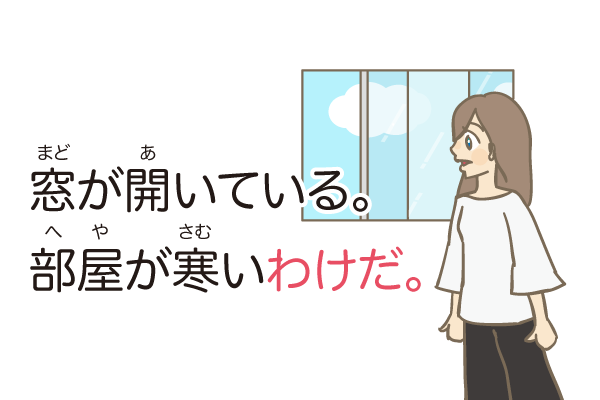
The second function is to express “makes sense.” English translations don’t work well here. With the above example, わけだ is used because you have fully understood why Tanaka-san has become a singer after hearing his song, like “The fact (that he has become a singer) makes sense to me now.” わけだ and the adverb 道理で which indicates “no wonder” or “it’s reasonable that…” is often used together. In this context, という doesn’t appear.
| 窓が開いている。道理で部屋が寒いわけだ。 The window is open. No wonder it’s cold in the room. |
| 鈴木さんの笑顔は素敵だね。子供から人気があるわけだ。 Suzuki-san’s smile is nice. (It’s reasonable) [he] is popular with children. |
| みんな練習をさぼっている。試合に勝てないわけだ。 Everyone neglects practice. (It’s reasonable) [we] cannot win games. |
You cannot replace わけだ with のだ in this function. However, はずだ is interchangeable.
| 窓が開いている。部屋が寒いはずだ。 The window is open. It should be cold in the room. |
| 鈴木さんの笑顔は素敵だね。子供から人気があるはずだ。 Suzuki-san’s smile is nice. It should be popular with children. |
| みんな練習をさぼっている。試合に勝てないはずだ。 Everyone neglects practice. So [we] should not win games. |
Summary (Rewording)
| 明日から仕事が始まる | 夏休みがもう終わるわけだ |
| Condition | Conclusion |
| [We] will start working tomorrow. Summer vacation is over soon. | |
The third function is to express summaries (rewording) just like のだ. You can roughly consider this as the equivalent to “in other words” in English. In this context, わけだ and のだ are interchangeable.
| 子供が産まれた。親になったわけだ。 [My] baby was born. In other words, [I] became a parent. |
| 指輪を渡された。プロポーズされたわけだ。 [I] was given a ring. In other words, [I] was proposed to [by my partner]. |
| ボブは引っ越す。明日からボブはいないわけだ。 Bob will move. In other words, [he] will not be [here] starting tomorrow. |
Interrogative Sentences
Asking Whether You Can Conclude Something Based on a Guess
| A. 飛行機に乗ったことがないん(だ / です)。 [I] have never tak en a flight. |
| B. ということは、海外に行ったことがないわけ(ですか)? That is to say, you haven’t been abroad yet, right? |
わけだ only works in the first function (Conclusions Based on a Guess) in affirmative sentences. It’s a very contextual question, which is to ask whether or not you can conclude something based on your guess. With the above example, you guessed that Mr. A has never been abroad based on the fact that he has never taken a flight and asked whether you can conclude that your guess is correct. Without such contexts, you cannot use わけだ in interrogative sentences.
| A. ロケットの爆発からいくつか発見が(あった / ありました)。 There are some discoveries from the explosion of the rocket. |
| B. 実験は失敗じゃないわけ(ですか)? (So that means) the experiment didn’t fail, right? |
You can replace わけだ with のだ here.
| 海外に行ったことがない(んだ / んですか)? |
| 失敗じゃない(んだ / んですか)? |
Negative Sentences
We showed you some negative sentences, e.g. 明日からボブはいないわけだ and 試合に勝てないわけだ. We have conjugated the verbs so far and they are plain negative sentences; however, you can actually conjugate わけだ like わけじゃない and わけがない and express various nuances in negative sentences. Let’s learn the sentence patterns.
…わけに(は・も)いかない: Improperness or Impossibility
| [私は] | 人生 を | 諦めるわけには(いかない / いきません) |
| [Topic / Subject] | Direct Object | Verb: Impossibility |
| [It’s not possible that] [I] give up [my] life. | ||
This sentence pattern indicates improperness or impossibility like “it’s not proper that…” or “it’s not possible that…” In general, you need to use volitional verbs here. The three, which are わけに, わけには, and わけにも, have the same nuance.
| 約束を破るわけに(いかない / いきません)。 [It’s not proper that] [I] broke a promise. |
| 指示を無視するわけにも(いかない / いきません)。 [It’s not proper that] [I] neglect directions. |
| 明日は遅刻するわけには(いかない / いきません)。 [It’s not possible that] [I] will be late tomorrow. |
…わけがない: Strong Negation
| 車が | 空を | 飛ぶわけが(ない / ありません) |
| Subject | Location to Pass | Verb: Strong Negation |
| [It’s unreasonable that] cars fly in the sky. | ||
This is related to the second function (Expressing “Make Sense”) in affirmative sentences and is roughly translated as “it’s unreasonable that…” or “there is no reason that…” Be careful. The level of negation is high.
| こんな辛い料理を食べられるわけが(ない / ありません)。 [It’s unreasonable that] [I] can eat spicy foods like this. |
| 3か月で日本語が身につくわけが(ない / ありません)。 [It’s unreasonable] to master Japanese within three months. |
You can reword them by using はずがない.
| こんな辛い料理を食べられるはずが(ない / ありません)。 [It shouldn’t be so that] [I] can eat spicy foods like this. |
| 3か月で日本語が身につくはずが(ない / ありません)。 [It shouldn’t be so] to master Japanese within three months. |
…わけではない: Denying Conclusions Based on a Guess
| ロケットが爆発しましたが、 | 実験 |
| Condition | Conclusion |
| The rocket has exploded, but [it doesn’t mean] the experiment has failed. | |
…わけではない has two functions. One of the two is related to the first function in affirmative sentences (Conclusions Based on a Guess). With the above example, you deny people’s guess that the experiment has failed. You may consider this as the counterpart “it doesn’t mean” in English. There is a typical combination which is to utilize “…(だ)からといって: just because.”
| 本が好きだけど、毎日読むわけじゃない(です)。 [I] like books, but [it doesn’t mean] [I] read [it] every day. |
| お金持ちだからといって、優しいわけじゃ(ない / ありません)。 Just because [people are] rich, [it doesn’t mean] [they are] kind. |
The second function is related to partial negation. We will carefully pick it up in the next lesson.
Summary
- In affirmative sentences, the explanatory わけだ expresses;
- conclusions based on a guess
- "makes sense”
- summaries (rewording)
- In interrogative sentences, the explanatory わけだ asks whether or not you can conclude based on your guess.
- In negative sentences, the explanatory わけだ expresses;
- improperness or impossibility
- strong negation
- denying conclusions based on a guess
Now you know the two types of explanatory expressions. We hope that the functions are not difficult for you. As you can see the above, the explanatory わけだ has some very important roles in affirmative and negative sentences. In addition, わけだ is greatly involved with partial negatives. In the next lesson, you will learn more about negative sentences.