
Last time, you learned how to express various means and standards, e.g. “電気によって車を動かしています (I’m moving a car by using electricity),” and “規制に沿って車を輸出しました (I exported a car following the regulations).” The compound particles, which are によって and に沿って, have a single particle counterpart, で . In this lesson, you will learn some compound particles which don’t correspond to any single particles.
How to Express Conditions by Using Compound Particles
First of all, let us clarify the difference between “conditions” and “conditionals.” We already explained in the previous lesson that conditionals indicate conditions by using main clauses and subordinate clauses, e.g. “if X is true, then Y is true.” By contrast, compound particles for conditions don’t create subordinate clauses, e.g. “X is true depending on Y.” Therefore, although both of them indicate conditions, the structure of sentences is different. Now, let’s check how it works with three types of conditions.
Change Depending on Various Conditions
English has a very powerful word to express conditions. That is “to depend.” However, in Japanese, we categorize conditions into three groups and need to use different compound particles depending on it.
次第で: The SUBJECT Will Change Depending on Conditions
| 花火大会は | 天候次第で | 中止(だ / です) |
| Topic / Subject | Condition | Predicate |
| The firework festival may be cancelled depending on the weather. | ||
次第で shows us how the subject will change depending on conditions.
| 給料次第でやる気が上下(する / します)。 Motivation goes up or down depending on salary. |
| 言い方次第で印象が(変わる / 変わります)。 Impression will change depending on how to say. |
次第 is a noun and hence you can use it as a predicate in the state-of-being style.
| 結婚は運次第(だ / です)。 Marriage is a lottery. |
| 試験は努力次第(だ / です)。 Examinations depend on [your] effort. |
に応じて: Someone Will Change the OBJECT Depending on Conditions
| [私たちは] | 成果に応じて | ボーナスを | 払う / 払います |
| [Topic / Subject] | Condition | Direct Object | Verb |
| [We] will pay a bonus depending on [your] results. | |||
に応じて shows how we change the object depending on conditions. Here, English translation doesn’t work well, but they may be close to “depending on,” “according to,” and “as.”
| 品質に応じて値段を変えて(いる / います)。 [We] change the price according to the quality. |
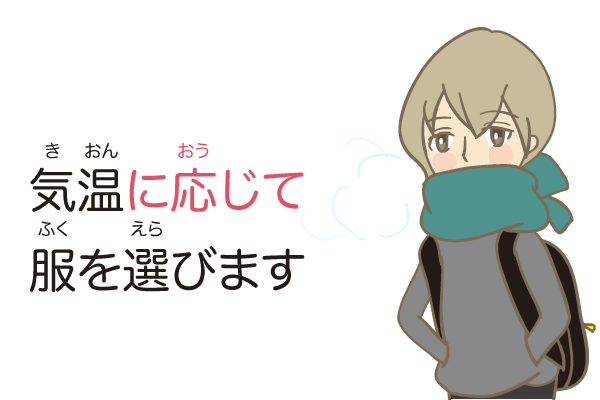
| 気温に応じて違う服を(着る / 着ます)。 [I] wear different clothes depending on the temperature. |
| 必要に応じて予防接種を(する / します)。 [I] will take vaccinations as needed. |
によって: There Are Various Outcomes Depending on Conditions
| 人によって | 色んな意見が | ある / あります |
| Condition | Subject | Verb |
| Each person has a different opinion. Lit. Depending on the person, there are various opinions |
||
によって expresses “variety” or “diversity” like “there are various outcomes depending on conditions.” Here, English translation also doesn’t work simply.
| 国によって文化は様々(だ / です)。 Cultures vary depending on individual countries. |
| パソコンによって独自の機能が(ある / あります)。 Each individual PC has its own original function. |
によって has a wide usage and can express the same thing as 次第で and 応じて. Therefore, によって is most commonly used to express conditions.
| 給料 次第で・によって やる気が上下(する / します)。 |
| 言い方 次第で・によって 印象が(変わる / 変わります)。 |
| 品質 に応じて・によって 値段を変えて(いる / います)。 |
| 気温 に応じて・によって 違う服を(着る / 着ます)。 |
The origin of によって is the verb: “よる: to depend.” Therefore, you can reword the examples above like this;
| パソコンの機能はメーカーに(よる / よります)。 The function of PCs depends on the maker. |
| やる気は給料に(よる / よります)。 Motivation depends on salary. |
| 値段は品質に(よる / よります)。 The price depends on the quality. |
No Change Regardless of Various Conditions
Here, you will learn the opposite concept to the above one, which is no change regardless of various conditions. The function is simpler. You can just consider it as the counterpart to “regardless of” in English.
を問わず and にかかわらず: Regardless of
| ビリヤードは | 性別を問わず | 楽しめ(る /ます) |
| Topic / Subject | Condition | Verb: Potential Form |
| Billiards is enjoyable regardless of gender. | ||
を問わず and にかかわらず have the same meaning and are the counterpart to “regardless of” in English.
| 経験を問わずエンジニアを募集して(いる / います)。 [We] are looking for an engineer regardless of his/her experience. |
| 参加人数にかかわらずイベントは(行う / 行います)。 [We] will hold the event regardless of the number of participants. |
を問わず and にかかわらず are not so common in conversation. We more often use ...ても since it can express the similar meaning. Note: you cannot always reword them. Here, two of the examples are applicable.
| ビリヤードは男でも女でも楽しめ(る / ます)。 Billiards is enjoyable even if [you] are male or female. |
| 参加人数が少なくても、イベントは(行う / 行います)。 Even if the number of participants is low, [we] will hold the event. |
Regarding the difference between the two, 問わず can be used with the following three groups while にかかわらず can be used with only the second and the third groups.
- 1. Nouns which have two aspects, e.g. “男女: man and woman” and “大小: bigness and smallness.”
- ラグビーは男女 を問わず・
にかかわらず(できる / できます)。 - Rugby can be played regardless of [whether you are] male or female.
- 2. Nouns which have some degrees, e.g. “年齢: age,” “性別: gender,” and “経験: experience.”
- 天候 を問わず・にかかわらず 試合は行われ(る / ます)。
- The game will be held regardless of the weather.
- 3. Nouns listed with their antonyms, e.g. “公立私立: public and private” and “成功失敗 success and failure.”
- 成功失敗 を問わず・にかかわらず 挑戦は素晴らしい(です)。
- Challenges are wonderful regardless of [whether they are] successes or failures.
*Note: the difference between No.1 and No.3 is that 男女 is one word while 公立私立 are two words which are listed in a row.
Only にかかわらず can be used with adjectives and verbs if you list it with its antonym or negation. This is equivalent to “regardless of whether…”
| 雨が降る降らないにかかわらず、試合は行われ(る / ます)。 The game will be held regardless of whether [it] rains or not. |
| 背が高い低いにかかわらず、バスケットボールで活躍(できる / できます)。 [You] can take an active part in basketball regardless of whether [you’re] tall or short. |
Be careful. You may sometimes see this phrase: にもかかわらず. However, this is different from にかかわらず, meaning “however” or “despite” like けれども and のに and referring to just one specific condition.
| 経験がないにもかかわらず仕事が(見つかった / 見つかりました)。 The job could be found though [I] don’t have experience. |
| 背が低いにもかかわらずバスケットボールで活躍(できる / できます)。 [You] can take an active part in basketball despite being short. |
Negative Conditions
The concept of negative conditions is similar to the conditionals that we looked at in the compound sentence section, and we will again use the terms “actual conditions” and “hypothetical conditions.” Depending on whether the conditions are actual or hypothetical, you need to use different phrases.
なしで and をぬきにして: Actual Conditions
| [私は] | 辞書なしで | 日本語を | 読んで(みる / みます) |
| [Topic / Subject] | Condition | Direct Object | Te-form + みる |
| [I] will try to read Japanese without a dictionary. | |||
When conditions are actual, you use なしで or をぬきにして. They have the same meaning as “without” in English, but ぬきにして sounds more formal than なしで. You can reword this by using negative sequential actions: Verb + ないで. For the sake of better understanding, we’ve provided examples of both:
| 乾杯なしですぐに(飲んだ / 飲みました)。 [We] drank right away without a toast. |
| 乾杯をしないで、すぐに(飲んだ / 飲みました)。 [We] drank right away without having a toast. |
| 建前をぬきにして、本音で議論を(しない / しませんか)? Won’t [you] discuss [it] with true intention without surface one? |
| 建前で議論をしないで、本音で(しない / しませんか)? Shall [we] not discuss [it] with surface intention, but true one? |
The focus particle は often appears in this context. That is to say, は is often placed before なしで and can replaces を of をぬきにして.
| 乾杯はなしですぐに(飲んだ / 飲みました)。 |
| 建前はぬきにして本音で議論を(しない / しませんか)? |
なしに and なくして: Hypothetical Conditions
| [私は] | 涙なしに | この話が | でき(ない / ません) |
| [Topic / Subject] | Condition | Object of Potential | Potential Form |
| [I] cannot tell this story without tears. | |||
When conditions are hypothetical ones, you use なしに or なくして. なくして sounds more formal than なしに. You could reword these sentences by using the conditional ば-form which also indicates hypothetical conditions.
| 努力なくして成長でき(ない / ません)。 [You] cannot improve without effort. |
| 努力をしなければ成長でき(ない / ません)。 If [you] don’t put in effort, [you] cannot improve. |
| 失敗なしに成功は(ない / ありません)。 There is no success without failure. |
| 失敗しなければ成功は(ない / ありません)。 If [you] don’t fail, there is no success. |
Summary
- 次第で expresses “The SUBJECT will change depending on conditions.”
- に応じて expresses “Someone will change the OBJECT depending on conditions.”
- によって expresses “There are various OUTCOMEs depending on conditions.”
- によって is interchangeable with both 次第で and に応じて.
- を問わず and にかかわらず are counterparts to "regardless of."
- なしで and をぬきにして both express "without", when based on actual conditions.
- なしに and なくして both express "without", when based on hypothetical conditions.
Congratulations! You have completed the compound particle section. As you learned, compound particles basically consist of a particle and the te-form of verbs, and there are some cases where they work like relative clauses. The variety of the usages may make them difficult to understand. Thus, we have made a table here showing all of the cases. Please check it as needed.


