Japanese Lessons 1-1-1 研修医の夜 / Night of the Intern
*These Japanese lessons are created based on the Terms of Use of the Copyrights of them; TITLE: Give My Regards to Black Jack, AUTHOR: Shuho Sato, and WEBSITE: Manga on Web.
Japanese Lessons 1-1-1 研修医の夜 / Night of the Intern
You can browse all of the pages by clicking the picture above and then move to any page via 「目次」 at the left. When you need English translations or explanations, please return here and refer them. This article covers from page 1 to page 19.
|
Table of Contents
[Japanese Script with English Translation]
[Recommended Links]
|
Japanese Script with English Translation
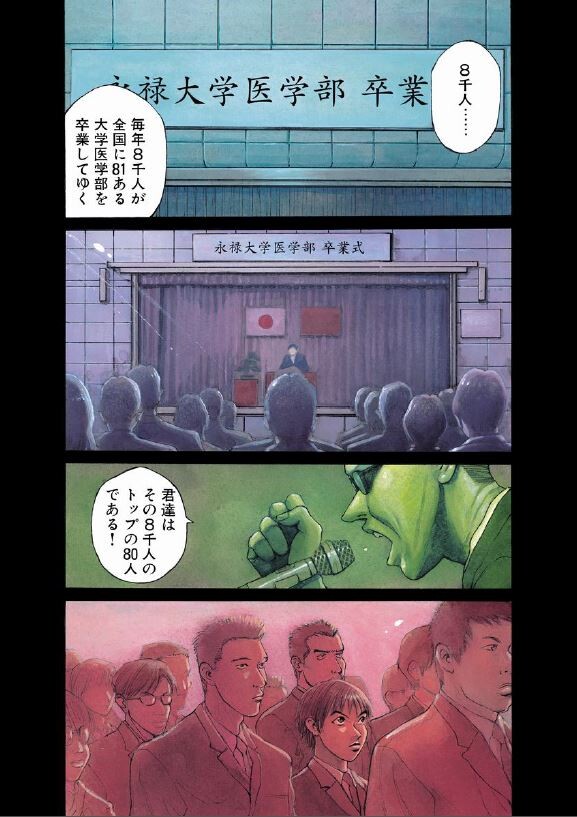
「8千人……、毎年8千人が全国に81ある大学医学部を卒業してゆく。君達はその8千人のトップの80人である!日本の医療を背負っていく*のは君達です!」
“8000… Every year 8000 students graduate from the 81 medical universities in this country. And, of those 8000, you are the top eighty! Japan’s medical future rests in your hands!”
One Point Lesson: Japanese Vocabulary
「背負う」 literally means “carry something on one’s back or shoulder”. However, it is often used for something responsible such as 「日本 (Japan) を背負う」 「借金 (debts) を背負う」 and 「未来 (future) を背負う」。
「眠そうだな、斉藤…。」「うん、さっきまで当直だったから。きのうの朝からもう24時間以上ここにいるよ。」「オレもさ。教授の実験の手伝いでさ…。3時間しか寝てねえ*…。」「じゃあ僕の勝ちだ。2時間しか寝てない!」
“You look pretty sleepy, Saito.” “Yeah, I just got off my shift. I’ve been here over 24 hours since yesterday morning.” “Yeah, me too. Helping out with the doctor’s experiments... I only slept 3 hours…” “Then, I win. I only slept 2 hours!”
One Point Lesson: Japanese Expressions
「~ねえ」 is a masculine expression and the same meaning as 「~ない」. This is very casual tone and often used everyday life, like for instance 「このテレビ、面白くねえ。」.
永禄大学医学部卒業から3ヶ月、僕は今永禄大学付属病院で研究医をしている。
It’s been 3 months since I graduated from Eiroku University, and currently I am working as an intern at the university’s hospital.
「ちゅうううう。」「ホラ斉藤!注射するのにイチイチ*そんな顔すんな!」
“Shluuuuuurp.” “Come on, Saito! Don’t make that kind of face every time you give an injection!”
One Point Lesson: Japanese Vocabulary
「イチイチ」 is always used for negative expressions.
研修医というのは要するに見習いだ。医者になるには大学で6年間医学を学び、医師国家試験に合格しなければいけない。ところがその国家試験は医学の知識をみるもので実技試験など*含まれていない(!)そこで、医師免許を取得した者の大半は、その後大学病院などで研修をする。
Interns are basically apprentices. To become a doctor, we need to study at a medical university for 6 years and then pass the national medical practitioners qualifying examination. But the national medical practitioners qualifying examination only tests medical knowledge. There is no practical exam! That’s why most graduates spend the next 2 years as an intern at a university hospital.
One Point Lesson: Japanese Vocabulary
The typical usage of 「など」 is “et cetera”, and “or something”. Here, it is used as something like “the like of”. 「など」 can be used for negative expressions.
「もっと術野を広げろ、斉藤。」「はい!」
“Widen the incision, Saito.” “Yes, Sir!”
「はあ…手術の後でうまそうにメシを食ってる自分が嫌だ。なあ、斉藤…。オレはこのままでは人の心を失くしてしまう…。「何言ってんだよ!*日本の医療を支えてるのは僕達なんだぞ!」「……。」
One Point Lesson: Japanese Grammar
If we plainly said this phrase 「何言ってんだよ」, it would be like 「何を言っているのだよ」. In spoken Japanese, particles are often omitted. For example, 「ご飯食べたい」 is also very natural, even though 「ご飯を食べたい」 is grammatically correct.
一日平均労働時間16時間。月給なんと…3万8千円!日給でなく月給である。うちの病院の待遇が特別に悪いわけではない。国立ではもう少し高いらしいが、私大*病院の研修医との月給は10万円以下の所が約7割を占める。その給料で寮も食事もないんだから生活できるわけない。で…
On average, interns work about 16 hours a day. My monthly salary is an astounding… 459 US dollars! Not my daily salary. My monthly Salary. That doesn’t mean my hospital’s treatment is bad. It seems public hospitals, pay a little more, but roughly 70% of interns at private university hospitals make under $1200 a month. Obviously no one could live off a salary like that with food and rent to pay for. So…
One Point Lesson: Japanese Vocabulary
「国立」 and 「私大」 are a contracted form of 「国立大学 (public university)」 and 「私立大学 (private university)」 respectively.
「それでは斉藤くん、本日は君に当院の当直のアルバイトをお願いする。斉藤英二郎、25歳、永禄大学医学部卒…この病院の当直は初めて…と。永大卒か…、エリートって奴だな…。」「はい!永大の名に恥じぬようがんばります!」「今日は初日という事で特別にもう一人当直がいる。ここのやり方は彼に訊いてくれ*。ではよろしく。」
“Well then, Mr. Saito, starting today, you will be starting a part-time shift at this hospital. Eijiro Saito, 25 years old, graduated from Eiroku University’s medical department. This will be your first time on duty… Well… from Eiroku, huh? So you’re one of the elite.” “Yes, sir! I will try my best not to soil Eiroku’s fine reputation!” “Since today is your first day, we also have someone else on duty. Ask him how things work around here. Glad to have you on board.
One Point Lesson: Japanese Vocabulary
Japanese has 3 words; きく related to “listening”. 「聞く」 is the most general one and has comprehensive meanings. 「聴く」 means more carefully listening than 「聞く」 and so it is often used for listening to music or presentations. And 「訊く」 means “ask” or “inquire”, but it is seldom used nowadays. 「聞く」 can be substituted for 「訊く」 today.
これが研修医の現実だ。
This is the reality of being an intern.
「初めまして!当直のバイトにやってきました永大の斉藤*です。あ…あの…、永大から当直に来ました斉藤です…。」「食っとけ…。食える時に食っとけ…。そして寝とけ。寝れるときに寝とけ。」
“Pleased to meet you! I’m Saito and I’m here from Eiroku as a part-time doctor. Um, I, uh… I’m Saito from Eiroku. I’m here for the short.” “Eat.. eat when you can eat. And sleep. Sleep when you can sleep.”
One Point Lesson: Japanese Cultures
When it comes to self-introductions in Japan, Japanese people usually say an organization’s name to which you belong first and then your name. Please note: he emphasizes the name of the university too much this time.
「誠同病院…ベッド数120…地域の中核をになう大規模病院…か。勤務医は3人…最初の人が院長で、さっきの人が牛田さん。今夜は僕と牛田さんの2人きり…。」
Seido Hospital, 120 beds, a pretty large hospital… taking on the majority of the area’s residents… hmm. Three doctors, the first person I met was the hospital director and that last guy was Mr. Ushida. Tonight it’s just me and Mr. Ushida.
「いてーよー!いてーよー!」*「急ぐぞ!こっから先は戦場だ!」「はい!」「患者は20歳の男性!30分程前にバイクで転倒、左足が折れています!」「血算、生化と血型を大至急!濃厚赤血球を10パック取り寄せろ!永大出!ラクテック全開、ハイドロコーン1000ミリ側管注しろ!遅いぞ!永大出!!終わったら血液交差適合試験しろ!」
“Aaahhh! Please! Help me!!” “Hurry! It’s going to be a war zone in there.” “Yes, sir!” “Patient is a 20 year old male! He fell off his motorcycle roughly 30 minutes ago. His leg is shattered!” “Get me his blood count, blood type, and a comprehensive chemical breakdown! Start! And bring me 10 packs of PRBCS. Eiroku Grad! Give him a lactec injection and 1000 milligrams of hydro-condone! Hurry it up, Eiroku!! Then, when you’re done, crossmatch his blood!
*Note: you don’t have to understand the medical vocabulary, just feel the how serious it is.
One Point Lesson: Japanese Grammar
If we plainly said this phrase 「いてーよ」, it would be like 「痛いよ」. This flection can be used by men and often seen in spoken Japanese such as 「したい → してえ」. If you were confused with 「してー」 vs. 「してえ」, please read them out. Since this is a spoken language, you will realize there is no difference.
「すみません…なんの役にも立てませんでした。」「落ち込んでいるヒマなんかねーぞ。始まるのはこれからだ。」
“Sorry… I wasn’t able to help at all in there.” “You are not got time to be depressed. The night is just starting.”
One Point Lesson: Japanese Grammar
As is similar to the above, if we plainly said this phrase 「ねーぞ」, it would be like 「ないぞ」. This flection can be used by men and often seen in spoken Japanese such as 「来ないよ → 来ねぇぞ」. If you were confused with 「ねーぞ」 vs. 「ねぇぞ」, please read them out. Since this is a spoken language, you will realize there is no difference.