
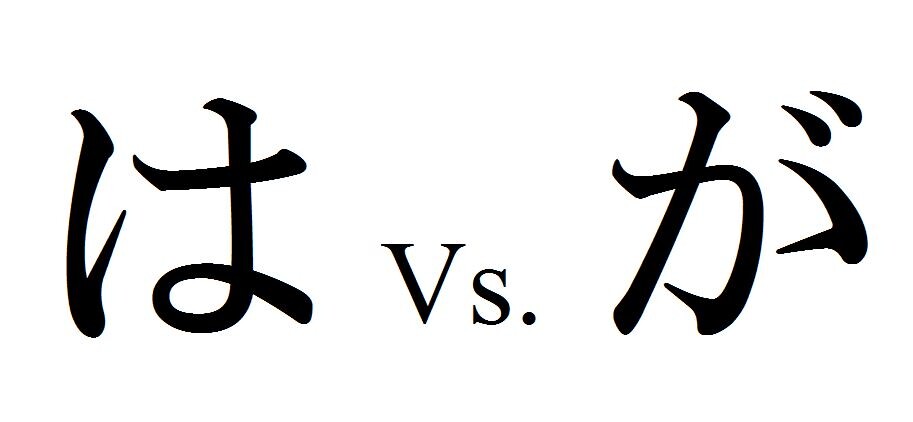
This article is part of Wasabi grammatical support service. We’re more than delighted to answer any grammatical questions you may have without any additional fee (*Wasabi user only). Today’s topic is regarding Japanese particle; は vs. が. Many Japanese language learners face difficulty using は and が. As a native Japanese speaker, Japanese particles are very useful because they allow us to express various things and nuances with only one particle. But, the variety can be one of the biggest things to confuse learners. In this article, we will try to clear up all doubts you may have about は vs. が.
Ultimate Explanation for the Difference Between は and が
The Basic Idea of は vs. が
Topic particle は
The topic particle identifies what it is that you're talking about, essentially the topic of your sentence. Let's say a person says, "Not student." This is a perfectly valid sentence in Japanese but it doesn't tell us much without knowing what the person is talking about. The topic particle will allow us to express what our sentences are about.
Identifier particle が
What if we don’t know what the topic is? What if I wanted to ask, “Who is the student?” What I need is some kind of identifier because I don't know who the student is. If I use the topic particle, the question would become, “Is who the student?” and that doesn't make any sense because "who" is not an actual person. This is where the 「が」 particle comes into play.
Quoted from Japanese Grammar Guide (Tae Kim)
This is one explanation for は and が. When you ask, “Are you a student?” you say 「NAME (you) は学生ですか?」, and when you ask, “Who is the student?” you say 「誰が学生ですか?」. The above source explains the basic idea of は and が very well. However, there is an irregular case: Japanese people say, 「NAMEが学生ですか?」, too. This is, perhaps unfortunately, a very natural expression and has some nuances (explained later in detail).
The Essential Idea of は vs. が
は Indicates Contrast
| オレンジは好きです。 |
| オレンジが好きです。 |
| *Vocabulary: オレンジ = orange, 好き = to like |
You might think the above sentences have the same meanings, but there is an important difference. That is contrast. 「オレンジは好き」 indicates that the speaker has something he or she dislikes, except for oranges. Practically, it looks like this:
| フルーツは好きですか? (As for fruits, do you like it?) |
| オレンジは好きです。 / オレンジが好きです。 |
The above is an example conversation. If someone asks you, “Do you like fruits?” and then you say, 「オレンジは好き」, this indicates that you like oranges, but don’t like other fruits very much; that is to say, you generally don’t like fruits. If you say, 「オレンジが好き」, this just indicates that you like oranges more than other fruits.
| 私はオレンジが好きです。 |
Don’t confuse the topic particle and contrast functions. The above sentence can be translated as, “As for me, orange is the one I like.” In this sentence, は is just a topic particle.
が Indicates New Information
| 雨が降っています。 |
| 雨は降っています。 |
| *Vocabulary: 雨 = rain, 降る = to fall |
Which sentence is proper when you notice that it started raining outside? There is also an important difference here. The answer is 「雨が降っています」 because of the new information introduced. When you notice or realize something for the first time, you need to use が. For example, when you realize it’s not rain, but snow, you say, 「雨(old information)は降っていません。雪(new information)が降っています。」
| 天気はどうですか?(How is the weather?) |
| 雨が降っています。 / 雨は降っています。 |
The above is another example conversation. When someone asks, “How is the weather?” and then you check the weather by opening a curtain or looking out the window, 「雨が降っています」 is a proper expression because you have just noticed that it is raining. When you want to say something like, “It started raining, but not snowing,” it will be something like 「雨は降っていますが、雪は降っていません」 because of the contrast. If someone asks you, 「雨は降っていますか?」 instead, 「雨は降っています」 is proper because the topic of the question is already 雨.
| NAMEが学生ですか? |
This sentence indicates that the speaker did not know or was not convinced that NAME is a student. For example, if someone says, 「Mark Zuckerbergは学生です。」, you can say, 「Mark Zuckerbergが学生ですか?」 because to you, this is new information. With a strong intonation, you can express your surprise as well.
Grammatical Rules for は vs. が (for Intermediate or Higher)
は and が have specific grammatical rules. In order to correctly use は or が, it may be better to learn them.
In Noun Clauses, が is Common
| 雨が嫌いな人は私です (I’m the person who dislikes rain)。 |
| オレンジが好きなのは私です(I’m the person who likes an orange)。 |
In Subordinate Clauses, が is Common, Except for the Following
When you try to make a long sentence, you may get confused about when to use は and が. The general rule is that が is usually used in subordinate clauses. Below, you will learn the exceptions.
When は is Used for Contrast
| お寿司は美味しいけど、納豆は美味しくない (Sushi is delicious, but Natto is not delicious)。 |
| これは面白いけど、あれは面白くない (this is interesting, but that is not interesting)。 |
When a Main and a Subordinate Clause Have the Same Subject
| お寿司は美味しくて、売り切れました (Sushi was delicious and was sold out)。 |
| このマンガは面白くて、有名になりました (This manga is interesting and became popular). |
When a Subordinate Clause Expresses a Reason for a Main Clause
| 明日は日曜なので、買い物に行きます(Since tomorrow is Sunday, I will go shopping)。 |
| 明日は休みなので、野球をします(Since tomorrow is day off, I will play baseball)。 |
Conclusion for は vs. が
| は | Topic particle, Contrast |
| が | Identifier particle, New information |
This table summarizes all you need to know. After understanding these concepts, the amount of reading you do can make a difference. As for the Japanese language, particles and inflections are key. Immerse yourself into native expressions.
If you have any doubts about Japanese grammar, please feel free to ask us. We will answer any questions with pleasure (*Wasabi user only)!
References
初級を教える人のための日本語文法ハンドブック
中上級を教える人のための日本語文法ハンドブック
Recommend Links
Japanese Particle に: Clear Up all Doubts You May Have


